
Bullying
Bullying is a serious issue that many children face in school. At Families Together, we know that bullying has a huge impact on a child’s ability to succeed in school and form relationships. That’s why we are committed to making sure you have resources to help you understand bullying, why it happens, how to prevent it and what you can do to deal with it if it is happening to someone you love.

Families Together Resources for Bullying

More Resources for Bullying
Kansas
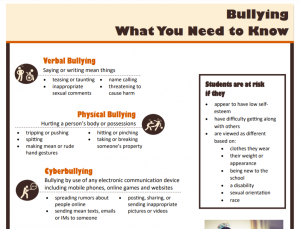
- *New – Bullying: What You Need to Know
- Kansas Anti-Bullying & Character Development Legislation (SB 68)
- Kansas Bullying Law – visual
- Understanding Bullying
- Kansas State Department of Education Bullying Resources
For Parents
- Help Your Child Recognize the Signs of Bullying
- Notifying the School About a Bullying Incident—Using a Template Letter
- The Individualized Education Program (IEP) and Bullying
- Record Keeping and Bullying
For Parents & Educators
- Bullying and Harassment of Students with Disabilities – Top 5 Facts Parents, Educators, and Students Need to Know
- Common Views and Myths about Bullying
- A Guide to Bullying and Cyberbullying
- National Bullying Prevention Center
- Respond to Bullying: Stop It, Spot It, and Support Kids Involved
- Understanding Bullying and Its Impact on Kids with Learning Disabilities or ADHD
- Use Positive Strategies to Protect Your Child with Disabilities from Bullying
For Students
Office for Civil Rights
- Dear Colleague Letter: 2014 Responding to Bullying of Students with Disabilities
- Dear Colleague Letter: 2013 Bullying of Students with Disabilities
- Dear Colleague Letter: 2010 Harassment and Bullying
- Harassment and Bullying Background, Summary, and Fast Facts
- Prohibited Disability Harassment: Reminder of Responsibilities under Section 504 of the Rehabilitation Act of 1973 and Title II of the Americans with Disabilities Act
Kansas Anti-Bullying, Cyberbullying & Character Development Legislation (HB 2758)
The 2013 Legislature amended the anti-bullying statute (KSA 72-8256) and, effective July 1, 2013, requires schools to include the following in their bullying policies:
1) Bullying means: a) any intentional gesture or any intentional written, verbal, electronic or physical act or threat either by any student, staff member or parent towards a student or by any student, staff member that is sufficiently severe, persistent, or pervasive that such gesture, act or threat creates an intimidating, threatening or abusive educational environment that a reasonable person, under the circumstances, knows or should know will have the effect of:
- Harming a student or staff member, whether physically or mentally;
- Damaging a student or staff member in reasonable fear of harm to the student or staff member; or
- Placing a student or staff member in reasonable fear of damage to the student’s or staff member’s property;
- Cyberbullying; or
- Any other form of intimidation or harassment prohibited by the board of education of the school district in policies concerning bullying adopted pursuant to this section or subsection € of K.S.A. 72-8205 and amendments thereto.
The 2008 Legislature amended the anti-bullying statute, and effective July 1, 2008, requires school districts to:
- adopt and implement a plan to address cyberbullying, and
- adopt policies prohibiting bullying on school property, in school vehicles, or at school-sponsored activities, and
- adopt and implement a plan to address bullying, which must include provisions for training and education of staff and students.
- upon request of a school district, the state board shall assist in the development of a grade-appropriate curriculum for character development programs.
Still have questions?
We are here to help.
Our services are free to families that include a child or youth with learning, behavioral, and/or health challenges. Our staff are also parents or family members of children with disabilities and/or special health care needs, so we understand that the process can be overwhelming and confusing at times.